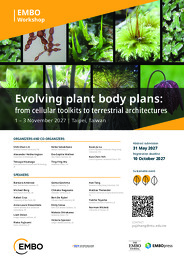
About the Workshop
From the earliest multicellular algae to the complex architectures of modern land plants, the evolution of plant form represents one of the most remarkable transitions in the history of life. How did simple cellular systems give rise to the extraordinary diversity of tissues, organs, and body plans that characterize today’s terrestrial flora? This EMBO Workshop will bring together an international community of researchers working at the interface of evolutionary biology, developmental biology, genomics, cell biology, and paleobotany to address this fundamental question. Through studies spanning algae, bryophytes, lycophytes, ferns, gymnosperms, and flowering plants, participants will explore the cellular and genetic innovations that enabled plants to colonize land and diversify into increasingly complex forms. Topics will include multicellularity, regeneration, morphogenesis, meristem evolution, developmental plasticity, tissue patterning, vascular innovations, and the evolution of reproductive structures. By integrating perspectives across scales—from molecular mechanisms to whole-organism architecture—the workshop aims to foster new insights into the origins, diversification, and future study of plant body plans.
Image credits: Dr. Alexander Hetherington and Dr. Michael Borg
About EMBO Courses and Workshops
EMBO Courses and Workshops are selected for their excellent scientific quality and timelines, provision of good networking activities for all participants and speaker gender diversity (at least 40% of speakers must be from the underrepresented gender).
Organisers are encouraged to implement measures to make the meeting environmentally more sustainable.