Your browser does not support or is disabling JavaScript.

stamp
MENU
 

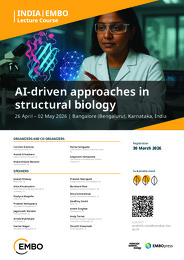
India|EMBO Lecture Course

AI-driven approaches in structural biology

26 April – 02 May 2026 | Bangalore (Bengaluru), Karnataka, India, India

  • Registration Deadline
  • 30 March 2026
  • Abstract Submission Deadline
  • 30 March 2026
  • Chosen Participants Will Be Notified By
  • 1 April 2026
  • Payment Deadline
  • 7 April 2026

Apply now!

Use #EMBOAIInStructuralBiology

Download calendar invitation

poster

Download
poster
▼

About the India-EMBO Lecture Course

Recent breakthroughs in artificial intelligence have transformed structural biology, enabling accurate protein structure prediction and de novo design at unprecedented scale. This EMBO Lecture Course will provide an in-depth and critical overview of these advances, while equipping participants with the conceptual foundations and computational skills to apply modern computational approaches to their own research.

Designed for early-career life science researchers, this EMBO Lecture Course covers AI-driven advances in protein structure prediction, de novo protein design, functional design and modelling of protein complexes using state-of-the-art computational tools, highlighting key applications in biotechnology.

Lectures will be complemented by practical sessions, enabling participants to engage directly with computational tools and publicly available AI-based resources. This EMBO Lecture Course will foster discussions on current limitations, the integration of experimental and computational data, and the responsible use of AI in the biosciences. Emphasis will be placed on the interpretability of AI, ensuring that trainees do not treat results as a black box, but instead learn to contextualise them within the conventional paradigms of structural biology.


About EMBO Courses and Workshops

EMBO Courses and Workshops are selected for their excellent scientific quality and timelines, provision of good networking activities for all participants and speaker gender diversity (at least 40% of speakers must be from the underrepresented gender).

Organisers are encouraged to implement measures to make the meeting environmentally more sustainable.


Programme


Registration

  • Registration Deadline
  • 30 March 2026
  • Abstract Submission Deadline
  • 30 March 2026
  • Chosen Participants Will Be Notified By
  • 1 April 2026
  • Payment Deadline
  • 7 April 2026


  • STUDENT/POSTDOCS EUR 100 (INR 10,000)
  • ACADEMIC EUR 200 (INR 20,000)
  • INDUSTRY EUR 750 (INR 80,000)

Registration includes:

  • Accommodation for the duration of the workshop (26th April to 1st May included)
  • All meals and special dinner
  • One day excursion (Saturday 2nd May)

Payment

Selected participants will receive payment instructions by email from C.Domene@bath.ac.uk and Anand Srivastava (anand@iisc.ac.in). The message will include full details on the available payment options.

Important notice: Participants are advised to be vigilant against fraudulent communications. All official payment requests will be sent exclusively from the workshop organizers via email. We will never request payment or personal information through unofficial channels. If you receive any suspicious messages, please contact the organizers before taking any action.

Cancellation Policy

Registration fees are non-refundable unless cancellation is due to a major, justified event, for which proof will be requested.

Selection criteria

Applicants will be selected based on the quality and relevance of their submitted documents (a single pdf file of no longer than 3 A4 pages, ARIAL font 11 point at least) and their fit for the workshop objectives. The selection process will consider:

  • Motivation letter – clarity of purpose, interest in the workshop, and expected benefits for the applicant’s research or career
  • Curriculum Vitae (CV) – academic background, research experience, and relevant achievements
  • Reference letter – endorsement from a supervisor/mentor/manager confirming the applicant’s suitability and potential contribution
  • Relevance of research – alignment with the themes and goals of the workshop
  • Diversity and balance – including career stage, institution, geographic representation, and gender, where appropriate

Selection decisions will be made by the workshop organizers and communicated to applicants via email. Only applicants who meet the criteria and demonstrate strong motivation and potential contribution to the workshop will be accepted.

Abstract guidelines

Abstracts should be no longer than 250 words and must clearly summarize the work to be presented. They should include a brief background to set the context, a statement of the objectives or aims, a summary of the methods used, the main results or findings, and the conclusions or implications of the work. Abstracts should have a clear, concise title (maximum 15 words) and list all authors and their affiliations. Keywords (up to five) may be included. The text should be written in clear, grammatically correct English and should not rely heavily on citations, although essential references may be included.

In addition, an optional graphical abstract may also be submitted. The graphical abstract should be simple and informative, using color where appropriate to convey the main message of the work. It may consist of a structure, graph, drawing, photograph, scheme, or a combination, with text limited to necessary labels and arrows. Do not include photographs, drawings, or trademarked items already used elsewhere in the abstract. The graphic should fit within a rectangular area of approximately 3.25 inches by 1.75 inches (≈ 8.25 cm × 4.45 cm) and be submitted at high resolution (e.g., TIFF, 300 dpi for color, 1200 dpi for black-and-white). Use legible sans-serif fonts (e.g., Helvetica) with a font size of around 8 pt (no smaller than 6 pt).

Poster specifications

Posters should be a maximum of A0 size (841 × 1189 mm / 33.1 × 46.8 in) in portrait orientation. Other dimensions may be accepted upon prior approval.

Travel grants and registration fee waivers

Travel grants and registration fee waivers are available for participants.

Selection of awardees is handled directly by the organizers. EMBO travel grants and registration fee waivers are allocated on the basis of the quality of the submitted abstract.

Applicants do not need to apply separately for these but should indicate on the registration form if they wish to be considered.

Additional travel grants are available for EMBC Associate Member States Chile, India, Singapore and Taiwan.

Child care grants

EMBO Courses and Workshops offers grants to offset additional childcare costs incurred by participants or speakers when participating at any EMBO Courses and Workshop funded meeting. Eligible costs include fees for a caregiver or child-care facility, travel costs for a caregiver, or travel costs for taking the child to the meeting etc. Please indicate on the registration form whether you would like to be considered for the grant. Please also describe how you intend to use the childcare grant and specify the sum that you will need.

Accessibility grants

EMBO offers accessibility grants to support participants at EMBO Courses & Workshops with any access needs. These grants cover up to 500 Euros for any additional costs e.g. to adapt the conference environment, or to be accompanied by someone to assist them where necessary.

Participants with access needs may apply for a grant via the registration system of the related EMBO event, or by emailing the organizers of the related EMBO event directly.


Code of conduct

Anti-harassment and non-discrimination policy

At EMBO, we believe that harassment and discriminatory behaviour are unacceptable in any setting.

Media and communications policy

Recording or communication of the presented data needs to be agreed upon by all concerned.

EMBO's code of conduct is applicable for all participants of this EMBO meeting and can be found here.


Contact

Mr A. Rohith
Email: arohith.cmc@vendor.iisc.ac.in

Carmen Domene
Email: C.Domene@bath.ac.uk

Anand Srivastava
Email: anand@iisc.ac.in


Venue

The Indian Institute of Science located in Bengaluru, Karnataka (India)

CV Raman Rd, Bengaluru, Karnataka 560012, India

Accommodation

Primary Venue: Hoysala Guest House, IISc Bangalore
Capacity: Can comfortably accommodate 50 participants from outside Bangalore
Some are shared and some individual (30).
Secondary Venue: at the nearby Raman Research Institute (RRI) campus (About 1–2 km apart)

Transport

Visit this link for transport details.

About the Area

The conference will be held at the Indian Institute of Science (IISc), Bangalore, a premier research institution set within a lush, green campus in north-central Bangalore. The city, known as the “Garden City of India,” is celebrated for its pleasant climate, tree-lined avenues, and numerous parks and lakes. Bangalore is a vibrant blend of tradition and modernity, with a rich cultural heritage reflected in its historic temples, palaces, and bustling markets, alongside a thriving tech and research ecosystem. The IISc campus provides a serene academic environment, well-connected to the city’s amenities and public transport. Nearby research institutes, including the Raman Research Institute (RRI) just 1–2 km away, add to the academic atmosphere and serve as backup accommodation if needed. Participants will enjoy convenient on-campus lodging at Hoysala Guest House, while being within easy reach of Bangalore’s cultural, culinary, and recreational attractions.

Sustainability at the meeting

The EMBO Courses & Workshops Programme assesses meetings based on the proposal and implementation of sustainability measures. Meetings can earn points across a range of measures, with each measure assigned a point value from one to five. These points classify the meeting into one of three sustainability levels, reflecting the organizers' commitment to enhancing the sustainability of their event. More information on the EMBO Courses & Workshops Sustainability Badge can be found here.

Some invited speakers from other continents are asked to give their talks remotely to save on travel.
The venue takes some energy efficiency measures and No single-use wares such as disposable cutlery, cups, plastic bottles or cans will be used.
A centrally located venue with good public transport connections and close to major transport hubs has been chosen.
Catering will include vegetarian days, locally sourced ingredients, and bottled water or single-use wares will be avoided.
Participants are requested to offset the CO2 footprint from the flights by paying the extra charge offered by most airlines.
Abstract books and programs will be shared in electronic form only.
A session on sustainability in HPC has been scheduled at the meeting.

Molecular Systems Biology